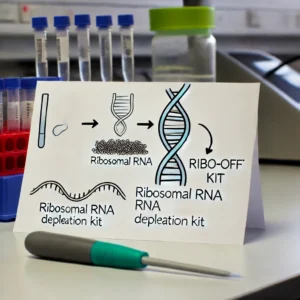
The Ribo-off rRNA Depletion Kit is a specialized tool designed to selectively remove ribosomal RNA (rRNA) from total RNA samples, allowing researchers to focus on the more biologically informative messenger RNA (mRNA) and other non-coding RNAs (ncRNAs). This depletion enhances the sensitivity, accuracy, and depth of RNA sequencing (RNA-seq) and other RNA-based experiments by preventing the overwhelming presence of rRNA, which constitutes 80-90% of the RNA in typical eukaryotic cells.
Why rRNA Depletion is Crucial in RNA Sequencing
In RNA sequencing workflows, the high abundance of rRNA can interfere with the detection of low-abundance RNA species, such as mRNA, long non-coding RNA (lncRNA), microRNA, and circular RNA. Removing rRNA from total RNA samples with the Ribo-off kit ensures that more sequencing reads are dedicated to these crucial RNA types, enabling a deeper exploration of the transcriptome. Studies on rRNA depletion and its impact on sequencing depth can be explored at NIH.gov and NCBI.
What Happens Without rRNA Depletion?
Without effective rRNA depletion, rRNA sequences will dominate the sequencing data, reducing the number of informative reads that capture the expression profiles of coding and non-coding RNAs. This results in:
- Reduced Sensitivity: Limited ability to detect low-abundance transcripts, which are often the most critical for understanding regulatory mechanisms and disease states.
- Wasted Sequencing Resources: A large proportion of sequencing reads will be consumed by rRNA, reducing the overall efficiency and increasing the cost of RNA-seq experiments.
Learn more about the effect of rRNA depletion on RNA-seq at PubMed.
Key Features of the Ribo-off rRNA Depletion Kit
- Highly Efficient rRNA Removal: The Ribo-off kit is designed to deplete over 90% of rRNA from total RNA, significantly enriching the mRNA and ncRNA fractions. This allows for deeper transcriptome profiling and a more accurate representation of gene expression. For detailed protocols on rRNA depletion, visit FDA.gov or CDC.gov.
- Broad Compatibility: The Ribo-off rRNA Depletion Kit is compatible with RNA extracted from multiple species, including humans, mice, rats, bacteria, and other model organisms. It also offers versions tailored for plant RNA research. This versatility makes it suitable for a wide range of projects, from human disease research to microbial studies. Find more information on species-specific kits at NCBI.
- Simple and Fast Workflow: The kit provides a streamlined protocol that integrates easily into existing RNA preparation workflows. After rRNA depletion, the RNA is ready for direct use in downstream applications like RNA-seq, cDNA library construction, and quantitative PCR. Detailed workflows can be reviewed on CDC.gov.
- Low RNA Input: The Ribo-off kit is designed to work with low input amounts of total RNA, making it suitable for precious or limited samples, such as biopsies or single-cell RNA preparations. Learn more about low-input RNA workflows at PubMed.
Applications of the Ribo-off rRNA Depletion Kit

The Ribo-off rRNA Depletion Kit is highly versatile and finds application in several key areas of molecular biology and transcriptomics:
- RNA Sequencing (RNA-seq): The most common application of rRNA depletion is RNA-seq, where removing rRNA dramatically improves the quality and depth of sequencing. By enriching for mRNA and non-coding RNAs, researchers can gain a more comprehensive view of gene expression patterns and regulatory networks. For protocols on RNA-seq and rRNA depletion, visit NIH.gov.
- cDNA Library Preparation: Depleting rRNA improves the quality of cDNA libraries by ensuring that they are enriched for the transcripts of interest. This results in more accurate downstream sequencing and gene expression analysis. Explore cDNA library protocols at NCBI.
- Transcriptomic Studies: The Ribo-off kit is indispensable in studies aiming to capture the full complexity of the transcriptome, including rare or low-abundance RNA species such as long non-coding RNAs (lncRNAs), circular RNAs, and microRNAs. Researchers studying differential gene expression, RNA editing, or alternative splicing rely heavily on rRNA depletion to ensure comprehensive coverage of these elements. Related research can be found at PubMed.
- Microbial Research and Pathogen Detection: In microbiology and virology research, the kit enables selective analysis of microbial and viral RNA, without interference from host rRNA. This is particularly valuable in studies of bacterial gene expression, viral replication, and host-pathogen interactions. Detailed studies on pathogen detection are available at CDC.gov.
- Single-Cell RNA-seq: Single-cell RNA sequencing (scRNA-seq) often uses limited amounts of RNA, making rRNA depletion critical for increasing the detection sensitivity of the remaining mRNA. This allows researchers to explore gene expression in individual cells, providing insights into cellular heterogeneity and rare cell populations. More information on single-cell applications can be found at NCBI.
Protocol Overview
The typical Ribo-off protocol involves a few key steps:
- RNA Extraction: Total RNA is extracted from the cells or tissue using standard RNA extraction protocols.
- rRNA Depletion: The Ribo-off kit is applied to the total RNA sample, selectively removing rRNA through hybridization and enzymatic digestion.
- Purification: After rRNA depletion, the remaining RNA (mostly mRNA, ncRNA) is purified and prepared for downstream analysis. More detailed protocol steps are available at FDA.gov.
Troubleshooting and Best Practices
While the Ribo-off kit offers a streamlined workflow, a few challenges may arise, particularly when working with different RNA types and species:
- Suboptimal rRNA Depletion: If rRNA removal is insufficient, ensure that the RNA extraction process was efficient, and the input RNA concentration is within the recommended range (typically 50-500 ng). In some cases, using species-specific probes may enhance depletion. For troubleshooting rRNA depletion issues, consult CDC.gov.
- RNA Degradation: Degraded RNA can affect the efficiency of rRNA depletion and downstream applications. It is essential to handle RNA carefully to prevent degradation by RNases. Use RNase-free reagents and equipment throughout the workflow. More details on RNA handling can be found at PubMed.
- Low RNA Yield: If RNA yields are low after rRNA depletion, consider optimizing the RNA input or pooling samples for better recovery. Additionally, the use of high-sensitivity RNA quantification methods, such as Qubit or Bioanalyzer, can help accurately assess RNA yields. Learn more about RNA quantification techniques at NIH.gov.
Future Directions in rRNA Depletion and Transcriptomics
As RNA sequencing technologies continue to advance, the need for efficient rRNA depletion solutions like the Ribo-off kit becomes even more critical. Emerging fields such as single-cell transcriptomics, spatial transcriptomics, and long-read RNA sequencing (using platforms like PacBio and Oxford Nanopore) all benefit from improved rRNA depletion strategies to ensure comprehensive and accurate analysis of the transcriptome.
Further advancements in automation and high-throughput applications of rRNA depletion are also expected to streamline workflows, particularly in large-scale genomic studies and clinical diagnostics. Stay updated with the latest research and innovations in rRNA depletion and transcriptomics at NCBI and NIH.gov.
Conclusion
The Ribo-off rRNA Depletion Kit is a critical tool for enhancing RNA sequencing precision by removing rRNA and allowing for deeper, more informative analyses of mRNA and non-coding RNA species. Its ease of use, efficiency, and versatility across multiple species make it an indispensable part of modern transcriptomic workflows. Researchers looking to maximize the value of their RNA-seq data, while minimizing sequencing costs, will find the Ribo-off kit to be an invaluable resource.
For more information, protocols, and research papers on rRNA depletion, visit CDC.gov, NIH.gov, and PubMed.